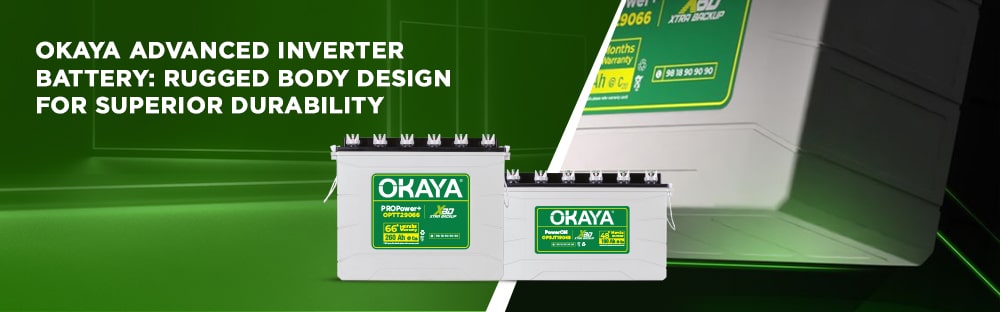
Okaya's checked 160Ah SJT and 160Ah TT product pages list a rugged, durable body with corner protection and securely fitted terminal protectors for added safety. This guide explains what the body design includes, what it does not cover, and how it fits with the rest of an UPS battery you choose for backup.
Okaya's checked 160Ah SJT and 160Ah TT product pages describe the body as stylish and durable, with two protection features:
1. Corner protection on the battery container.
2. Securely fitted terminal protectors for added safety.
The 160Ah TT product page also describes the construction as rugged. Similar features on other SJT and TT models should be confirmed from their individual product pages. The body is one part of the battery; backup hours, warranty and upkeep are covered by other specifications.
The checked pages are the 160Ah SJT (Super Jumbo Tubular) and the 160Ah TT (Tall Tubular). Both are 100% tubular designs; SJT sits in a Super Jumbo container and TT in a tall container. Other SJT models (110Ah to 160Ah) and TT models (160Ah to 310Ah) should be checked on their own product pages. For a comparison of the two designs, read SJT vs TT inverter batteries.
Container design also decides the footprint and weight you need to plan for:
1. SJT, 110Ah to 160Ah: 540 x 210 x 317 mm. The 160Ah 60-month model has a listed net weight of 50.3 kg.
2. TT, 160Ah to 260Ah: 508 x 198 x 404 mm. The 160Ah 60-month model has a listed net weight of 55.9 kg.
3. TT 310Ah: 510 x 215 x 413 mm.
Check these against your shelf or trolley using the inverter battery size details on the product listing.
The body design adds protection to the container corners and terminals, but it does not by itself set backup hours or service life. Okaya's category FAQ gives a typical service life of 4 to 6 years with proper care, and real backup varies with temperature, battery age, the inverter used and the battery's state of charge.
Compare declared backup hours at a load close to yours. Okaya's Certified Backup Hours are tested under the UMHD (Urban Metro Heavy Duty) load cycle in NABL-accredited laboratories and printed on the packaging. For example, the 160Ah TT with a 60-month warranty is certified at 3:15 at 400 W and 20:15 at 100 W, in hours:minutes. Okaya also states that XBD+ gives up to 15 to 20% longer backup than a conventional tubular battery of the same Ah capacity.
Okaya's SJT product page lists a vent-plug design that prevents spills and a float design that allows spill-free water topping without removing the float plug. Six ceramic water-level indicators show the level, and SJT batteries have all water inlets on one side in a 6x1 layout. Most models need only 1 to 2 water top-ups a year; use the water specified in the product manual or by Okaya Care.
Installation is typically arranged through your Okaya dealer, and you should not rewire the terminals yourself unless you are trained. Warranty is 48 to 66 months depending on the model, and registration is paperless. Message Okaya Care on WhatsApp at +91 9818 909090, write to care@okaya.in, or use the dealer locator to find nearby Okaya dealers in your area. For SJT models, see SJT inverter battery for home.
Okaya's checked 160Ah SJT and 160Ah TT product pages list a durable body with corner protection and securely fitted terminal protectors for added safety.
Which Okaya batteries have corner and terminal protection?
The checked 160Ah SJT and 160Ah TT product pages list them. Similar features on other SJT and TT models should be confirmed from their individual product pages.
Does a rugged body increase battery life?
It adds protection to the corners and terminals but does not set backup hours or service life. Okaya's category FAQ gives a typical service life of 4 to 6 years with proper care.
How heavy is an Okaya inverter battery?
The 160Ah 60-month SJT model has a listed net weight of 50.3 kg, and the 160Ah 60-month TT model 55.9 kg.
How big is an SJT or TT battery?
SJT batteries from 110Ah to 160Ah measure 540 x 210 x 317 mm. TT batteries from 160Ah to 260Ah measure 508 x 198 x 404 mm, and the 310Ah TT measures 510 x 215 x 413 mm.
How often does an Okaya inverter battery need water?
Okaya states that most models need only 1 to 2 top-ups a year. Use the water specified in the product manual or by Okaya Care.
What warranty do Okaya inverter batteries have?
Total warranty is 48 to 66 months depending on the model, made up of a flat period and a pro-rata period.
To compare the current inverter battery price, Okaya battery price and tubular battery price for each capacity, visit the Okaya shop.
 OKAYA POWER PVT. LTD.
ENERGIS D-7, 3rd & 4th Floor, Rohtak Rd,
Udyog Nagar, Mangolpuri,
New Delhi - 110041, INDIA
© 2026 All Rights Reserved to Okaya Power Private Limited